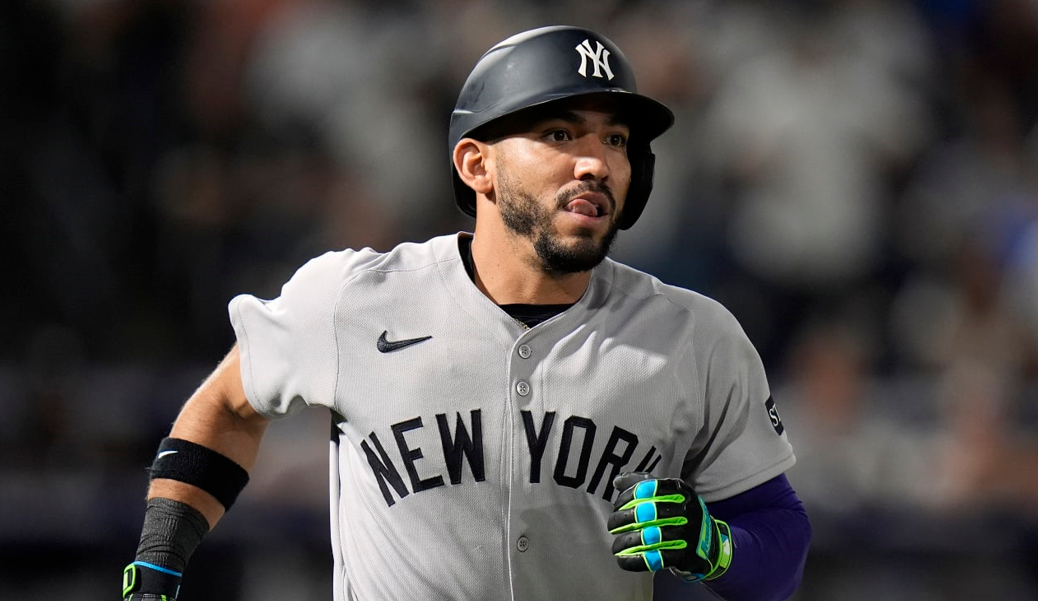
José Caballero ABS Challenge: A Historic First for Major League Baseball
The José Caballero ABS challenge is already one for the record books — and the 2026 MLB season had barely drawn its first breath when it happened. On Opening Night at Oracle Park in San Francisco, New York Yankees shortstop José Caballero stepped into a moment that no player in over a century of professional baseball had ever experienced before him. With a simple tap of his helmet, he triggered the very first Automated Ball-Strike challenge in a regular-season Major League Baseball game.
For all the pre-season buzz surrounding robot umpires and tech-driven officiating, nobody could have predicted the milestone would arrive so quietly — or that it would come with an awkward Netflix subplot. Welcome to 2026 baseball.
What Exactly Happened During the José Caballero ABS Challenge?
It was the top of the fourth inning, and the Yankees were already sitting on a comfortable 5-0 cushion against San Francisco. Giants ace Logan Webb opened Caballero’s at-bat with a 90.7 mph sinker that clipped the high, inside portion of the plate. Home plate umpire Bill Miller — a big-league officiating veteran since 1997 — punched it as a strike without hesitation.
Caballero wasn’t convinced. Moments after the call, he tapped his helmet, activating the ABS system and making himself a permanent footnote in baseball lore. The 12 Hawk-Eye cameras tracking the stadium then rendered their verdict, and results appeared on the Oracle Park scoreboard within seconds: the challenge was denied. Miller’s call stood.
“I wanted to go for it,” Caballero said after the game. “I thought it was a little higher than what it showed, but at least it was close.” Down 0-1 in the count, he eventually grounded out two pitches later. Not the heroic story arc baseball history usually reserves for its firsts — but history doesn’t always cooperate.
For more on the biggest stories shaking up celebrity news and sports culture in 2026, we’ve got you covered.
CREDIT: https://www.youtube.com/@yesnetwork
The Netflix Moment That Almost Buried the José Caballero ABS Challenge
Here’s where things get genuinely cinematic. At the exact moment Caballero tapped his helmet, Netflix — airing its first-ever official MLB broadcast — was mid-interview with Giants manager Tony Vitello. The network kept rolling, leaving viewers at home to piece together the historic moment from context clues rather than live coverage.
Vitello himself didn’t even see it happen. “I only used the restroom one time tonight,” he said with characteristic dry humor, “and it happened to be the time I was supposed to be doing a Netflix interview.” By the time he returned, the challenge was already settled and the game was moving forward.
It’s a fitting, almost comedic footnote for a milestone that rewired how baseball works. The most significant officiating development in the sport’s modern era — and the broadcast was in the bathroom.
How the ABS System Works — and Why the José Caballero ABS Challenge Matters
The Automated Ball-Strike Challenge System, officially powered by T-Mobile, is built on Hawk-Eye tracking technology — the same infrastructure used in tennis and cricket officiating for years. When a batter, pitcher, or catcher taps their helmet immediately after a questionable call, the system pulls up a hyper-precise 3D model of the pitch’s flight path and compares it against that specific player’s calibrated strike zone.
Each player’s zone is individual. The top is fixed at 53.5% of the player’s height, the bottom at 27%, and the width remains the standard 17 inches across home plate. Every MLB player was measured before the season began, making the zone a genuinely personalized boundary rather than a one-size-fits-all estimate.
Teams receive two challenges per game. A successful challenge is retained — lose one, and you still have another in reserve. Blow both, and unless the game pushes into extra innings, that’s it for your review options. During spring training this year, the success rate landed at 52.2%, with pitchers and catchers edging out hitters slightly in accuracy. It’s a strategic layer on top of an already chess-like game.
The system is deliberately designed as a hybrid model — human umpires still call the overwhelming majority of pitches, and the ABS exists only as a correction mechanism for the clearest misses. Traditionalists can breathe; the robot isn’t replacing anyone entirely.
Years of Testing Led to the José Caballero ABS Challenge Moment
None of this arrived overnight. MLB began piloting the technology in the minor leagues as far back as 2019, quietly stress-testing it through thousands of games before it ever touched the big-league stage. Spring training in both 2025 and 2026 served as the final proving ground, and the data came back encouraging — roughly 2.6% of all pitches were challenged during those sessions, with results delivered fast enough that managers barely had time to object.
The trending sports and entertainment stories of 2026 don’t get much bigger than this one. The Joint Competition Committee gave the green light last September, clearing the system for full regular-season and postseason use. Opening Night 2026 became the moment all of that groundwork finally paid off — and Caballero just happened to be standing at the plate when history arrived.
The Yankees, for their part, had been running internal challenge drills for weeks leading into the season. Nothing about Caballero’s decision was impulsive — it was calculated, even if the outcome didn’t swing his way.
What the José Caballero ABS Challenge Signals for the Future of Baseball
Win or lose, the Caballero challenge represents something bigger than a single overturned — or in this case, upheld — call. It signals a philosophical shift in how baseball relates to accountability. For decades, bad ball-strike calls were simply accepted as part of the game’s character, its quirky human texture. Now there’s a mechanism to push back, within limits and without chaos.
Logan Webb summed it up from the pitcher’s side with refreshing simplicity: “It felt like a strike. First one of the year, so I’m glad it went our way.” That’s the beauty of the system — both sides get the same technology, the same transparency, the same data. Nobody is left arguing with a ghost.
Whether the ABS challenge reshapes strategy at the plate, empowers pitchers to throw with even more precision, or simply speeds up the pace of games remains to be seen across a full 162-game season. But one thing is already certain: baseball changed on March 26, 2026, and José Caballero’s name will be in the footnote every time someone looks it up.
Frequently Asked Questions About the José Caballero ABS Challenge
Who made the first ABS challenge in MLB history?
New York Yankees shortstop José Caballero made the first Automated Ball-Strike challenge in MLB regular-season history on Opening Night 2026 against the San Francisco Giants. He challenged a strike call from umpire Bill Miller on a Logan Webb sinker, but the original call was upheld.
Did José Caballero win his ABS challenge?
No — the José Caballero ABS challenge was unsuccessful. The Hawk-Eye system confirmed umpire Bill Miller’s strike call on Logan Webb’s 90.7 mph sinker was correct. Caballero fell to an 0-1 count and eventually grounded out two pitches later.
How does the MLB ABS challenge system work?
A batter, pitcher, or catcher can challenge a ball-strike call by tapping their helmet immediately after the ruling. The Hawk-Eye camera system then reviews the exact pitch location against the batter’s personalized strike zone and displays the result on the scoreboard within seconds. Each team starts with two challenges per game, and a successful challenge is retained.
When was the ABS challenge system approved for MLB regular-season play?
MLB’s Joint Competition Committee approved the Automated Ball-Strike Challenge System for regular-season and postseason use in September 2025. The technology had been tested in the minor leagues since 2019 and in major-league spring training during 2025 and 2026 before receiving full approval.
Conclusion
Whether you’re a die-hard Yankees fan or a baseball skeptic who thinks the robots are taking over, the José Caballero ABS challenge is impossible to ignore. It’s a small gesture — a helmet tap — carrying the weight of a sport reinventing its relationship with accuracy. The first challenge was lost, but the door it opened could reshape how the game is played and argued about for generations. What do you think about MLB’s new ABS system? Is this the future baseball needed — or is the human element of the umpire being quietly eroded? Drop a comment below!