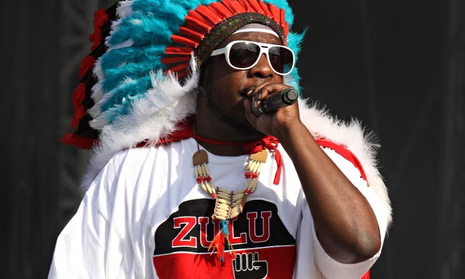
Afrika Bambaataa dead at 68 — the news broke on April 9, 2026, sending shockwaves through the global hip-hop community and beyond. The Bronx-born DJ, rapper, and cultural architect who helped give birth to an entire movement passed away in Pennsylvania from complications related to prostate cancer. He was 68 years old, and the world he helped create would never quite be the same.
For anyone who has ever danced at a block party, heard a breakbeat, or felt the pulse of electronic funk — this one hits differently. Bambaataa wasn’t just an artist. He was a force of nature who reshaped what music, and even community, could look like.
How Afrika Bambaataa Dead at 68 Became Breaking News Worldwide
Word of his passing spread rapidly after TMZ first reported the story on April 9. Within hours, the Hip Hop Alliance — co-founded by legends including Chuck D and KRS-One — issued an official statement confirming the loss. His attorney separately confirmed the cause of death to the Associated Press: prostate cancer.
Kurtis Blow, serving as executive director of the Hip Hop Alliance, acknowledged the complexity of Bambaataa’s story even while honoring his artistic contributions. The statement described him as “a foundational architect of Hip Hop culture” whose vision transformed the South Bronx into the symbolic birthplace of a global movement. That tension between legacy and controversy defined his final chapter — and still defines the conversation today.
For more on breaking celebrity and music deaths, visit our celebrity news section for ongoing coverage.
Credit: https://www.youtube.com/@WillieDLive
From Gang Member to Global Icon — The Rise Behind Afrika Bambaataa
Born Lance Taylor on April 17, 1957, in the South Bronx, Bambaataa grew up surrounded by the raw energy and danger of New York City street life. He was a member of the Black Spades, one of the Bronx’s most powerful gangs at the time. But a life-changing trip to Africa — won through an essay contest — rerouted everything.
Inspired by the 1964 film Zulu and the communities he encountered during his travels, he returned home with a radical idea: turn the gang into something else entirely. He renamed himself after the Zulu chief Bhambatha and founded the Universal Zulu Nation in 1977, transforming street conflict into creative competition through music, dance, and art.
That pivot didn’t just save lives in his neighborhood. It helped create hip-hop culture as the world knows it. Alongside DJ Kool Herc and Grandmaster Flash, Bambaataa became one of the three founding fathers of the genre, pioneering breakbeat DJing and spreading the movement to every corner of the globe.
Planet Rock and the Sound That Changed Everything
If you want to understand why Afrika Bambaataa mattered musically, start with “Planet Rock.” Released in 1982 with his group Soulsonic Force, the track was unlike anything hip-hop had produced before. It wove together drum machines, futuristic synthesizers, and a synth hook borrowed from Kraftwerk’s “Trans-Europe Express” into something entirely new — electro-funk was born.
“Planet Rock” charted on the Billboard Hot 100 and dominated dance floors worldwide. It didn’t just become a hit — it opened a door that artists have been walking through ever since. Electronic music, techno, dance-pop, and countless sub-genres owe a debt to what Bambaataa did in that recording session.
His 1982 tour was equally historic, marking one of the first times rap music was brought to mainstream venues on a large scale. He followed up with a top-five Dance Club Songs hit in 1991 with “Just Get Up and Dance,” proving his commercial appeal stretched across a full decade of evolving sounds.
A Legacy Shadowed — Afrika Bambaataa’s Controversial Final Years
No honest account of Afrika Bambaataa’s life can ignore the serious and deeply troubling allegations that emerged in his later years. In 2016, activist Ronald Savage publicly accused Bambaataa of sexually abusing him when he was a teenager. More accusations followed — from multiple individuals, across different decades — and Bambaataa stepped down from his leadership role at the Universal Zulu Nation that same year.
In 2021, a civil lawsuit was filed against him under New York’s Child Victims Act by an anonymous plaintiff known as John Doe, who alleged repeated abuse between 1991 and 1995. Bambaataa never responded to the legal filing and did not appear in court. In 2025, a judge issued a default judgment against him. The case was never resolved in any criminal court, but the civil finding against him was a matter of public record by the time of his death.
French hip-hop artist Solo of Assassin also alleged abuse in a 2024 memoir, adding yet another voice to an already devastating chorus. The reaction in the hip-hop world was divided — some, like KRS-One, chose to separate the art from the man. Others within the community felt there was no separating the two.
What the Hip-Hop World Is Saying About Afrika Bambaataa Dead at 68
Tributes and reactions poured in from across the music industry — though many were careful, measured, and notably absent of the uncomplicated praise typically reserved for departed legends. The Hip Hop Alliance’s statement walked a deliberate line, honoring his cultural contributions while acknowledging that “his legacy is complex.”
KRS-One, however, leaned toward preservation of the artistic record. “For me, if you keep it hip-hop, nothing can be taken away from Afrika Bambaataa,” he said, reflecting a view shared by some old-school figures who see his foundational work as inseparable from hip-hop history itself.
Other voices in the community pushed back — some survivors and advocates calling for clarity over comfort. The debate over how to honor someone with such a fractured legacy is unlikely to end anytime soon. It’s a conversation the culture needs to have, even if there are no easy answers.
Stay up to date with the latest music and culture conversations on our trending now page.
Afrika Bambaataa Dead at 68 — Understanding His Permanent Place in Music History
Whatever lens you view his life through, the cultural footprint Afrika Bambaataa left behind is undeniable. He did not merely participate in hip-hop’s origin story — he helped write it. The Universal Zulu Nation became the first formal hip-hop organization, officially founded on November 12, 1977. His philosophy of “peace, unity, love, and having fun” became core pillars of the culture’s early identity.
His influence stretched from the South Bronx to Tokyo, from London to Lagos. Artists in electronic music, dance, R&B, and rap have all been touched — whether knowingly or not — by what he built in those early Bronx block parties. That reach doesn’t disappear because of the darkness that followed. It coexists with it, uncomfortably and permanently.
For a full biography and discography, visit his Wikipedia page.
Frequently Asked Questions
How did Afrika Bambaataa die?
Afrika Bambaataa died on April 9, 2026, in Pennsylvania from complications related to prostate cancer. His lawyer confirmed the cause of death to the Associated Press shortly after the news broke.
How old was Afrika Bambaataa when he died?
He was 68 years old at the time of his passing. Born Lance Taylor on April 17, 1957, in the Bronx, he died just eight days before what would have been his 69th birthday.
What was Afrika Bambaataa best known for?
Bambaataa is best known for co-founding hip-hop culture alongside DJ Kool Herc and Grandmaster Flash, and for his landmark 1982 single “Planet Rock” with Soulsonic Force. He also founded the Universal Zulu Nation, the first formal hip-hop organization, in 1977.
Why was Afrika Bambaataa controversial?
Starting in 2016, multiple individuals came forward with allegations of child sexual abuse against Bambaataa spanning several decades. He resigned from the Universal Zulu Nation that year, and in 2025 a civil court issued a default judgment against him in a lawsuit filed under New York’s Child Victims Act. No criminal charges were ever filed before his death.
Final Thoughts
The story of Afrika Bambaataa dead at 68 is not a simple one — and it shouldn’t be told as if it were. He was a visionary who helped transform gang culture into global art, and a man whose personal history left lasting harm. Both of those things are true at once. Hip-hop, like all living cultures, will have to decide how to carry that weight forward. What do you think — how should we remember figures whose art and actions exist in such sharp contradiction? Drop a comment below and let us know.